



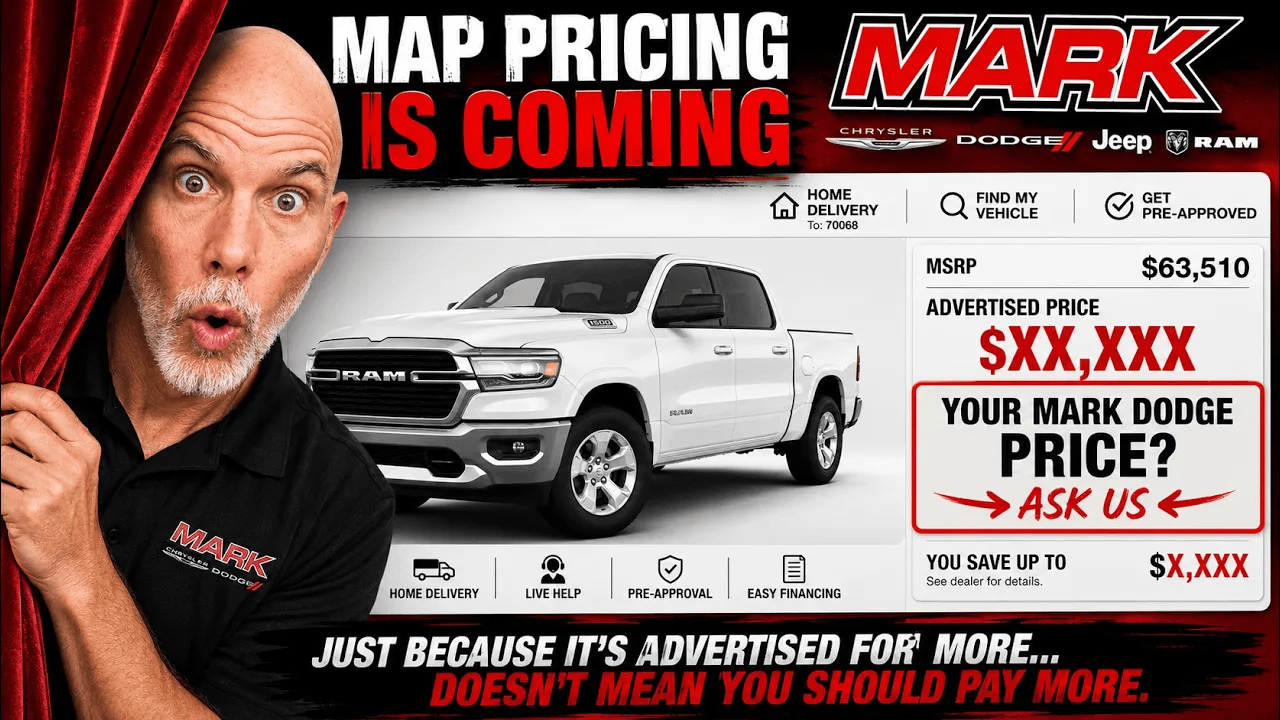
WATCH : What Is MAP Pricing and What Does It Mean When You're Buying a Vehicle? There's a change coming to the way some vehicles are advertised, and it's something every vehicle shopper should understand. It's called MAP pricing. MAP stands for Minimum Advertised Price. And the most important word in that phrase is advertised. MAP pricing can affect the price a dealership is permitted to publicly display in certain advertising. But here's the important part for shoppers: Just because a vehicle is advertised for more doesn't necessarily mean you should pay more. As MAP pricing becomes more common, the number you see advertised may become only one part of the shopping process. That makes knowing what questions to ask — and comparing dealerships — more important than ever. What Does MAP Pricing Mean for Car Buyers? For years, technology has made vehicle shopping more transparent. Instead of visiting dealership after dealership, you can sit on your couch and compare vehicles, prices, dealerships, reviews and buying processes from practically anywhere. MAP pricing changes part of that equation because there may be limits on the price that can be publicly advertised. That means shoppers should start asking some additional questions: What can you actually sell this vehicle for? What incentives do I qualify for? Are there additional savings available? Can I get the complete numbers in writing before making a decision? The advertised price is important. It just may not tell you everything you need to know. Minimum Advertised Price Isn't Necessarily the Selling Price This distinction is important. MAP is about advertising. So if one dealership advertises a vehicle for a certain amount, don't automatically assume another dealership can't offer a better deal simply because its advertised price looks similar. Ask. If a dealership has found a more efficient way to operate that allows it to save you money, wouldn't you want the opportunity to find out? That's where our philosophy at Mark Dodge comes in. Our Focus Is Affordability The affordability problem in the automobile business is real. Vehicles are expensive. Financing has become expensive. Insurance has become expensive. There's already enough pressure on the customer's wallet. So we keep asking a very simple question: If we can save you more money, why wouldn't we? Our approach isn't built around what another dealership is doing. We're constantly asking ourselves: How can we lower our costs? How can we turn inventory faster? How can we use technology better? How can we process transactions faster? How can we use remote employees effectively? How can we improve shipping? How can we handle titling and registration more efficiently? In other words, how can we grow without adding unnecessary expenses? We're not trying to build the cheapest operation. We're trying to build the most efficient operation we can. There's a difference. Efficiency Should Benefit the Customer Nearly a century ago, Henry Ford advocated an idea that still resonates with us today: a business shouldn't simply focus on charging the maximum amount the market will bear while paying its workers the minimum they'll accept. The idea was to build better systems and greater efficiency so a company could take care of its employees while making its products more affordable to customers. We believe there's still a lesson there. When technology, scale and better processes allow us to operate more efficiently, we want those efficiencies to benefit our customers. That philosophy has sometimes gotten attention in the automobile industry. Our pricing has probably ruffled some feathers along the way. That's okay. Other dealerships aren't our customers. You are. Our Pricing Philosophy Didn't Start With MAP This isn't a new strategy created because advertising rules are changing. Consider what happened during COVID. Vehicle inventories became incredibly tight. Demand exploded. In many parts of the country, customers were paying thousands of dollars over sticker simply to get a vehicle. We kept asking the same question we'd always asked: How can we save our customer money? At one point, we were selling more vehicles in a month than we physically had sitting on the ground because customers were purchasing vehicles that were still on their way to us. We could have looked at that scarcity as an opportunity to simply charge more. Instead, we continued looking for ways to discount. Our pricing philosophy isn't an advertising campaign. It's how we do business. MAP Pricing Makes Comparing Dealerships Even More Important As the way vehicles are advertised changes, consumers may need to change the way they shop. Don't assume the number you see online tells the entire story. And don't assume every dealership displaying a similar advertised price will ultimately offer you the same deal. Compare more than the advertised number. Look at: Final vehicle pricing Available incentives Trade value Financing Dealer fees Customer reviews Transparency Buying process Delivery options Titling and registration Access to knowledgeable people when you need help The goal should be to understand the complete transaction, not just one number in an advertisement. Think Bigger Than Your ZIP Code Mark Dodge is a brick-and-mortar Chrysler, Dodge, Jeep and Ram dealership in Lake Charles, Louisiana. We're a real dealership in a real place. But we've also built the infrastructure to operate nationally. That means you don't have to live in Louisiana to buy from Mark Dodge. Customers can purchase and finance vehicles remotely. Paperwork can be reviewed ahead of time and documents can be signed remotely. We've worked with customers across the country and even customers completing transactions while overseas, including members of the military. And digital doesn't mean you're on your own. When you have a question, you have a real person you can call. We've also built logistics, titling and registration processes specifically because so many of our customers don't live anywhere near Lake Charles. So when you're shopping for your next vehicle, think bigger than your ZIP code. Give your local dealership an opportunity. Shop regionally. But give yourself the opportunity to compare nationally too. MAP May Change the Advertisement. It Doesn't End the Shopping. That's the most important thing we want shoppers to understand. MAP pricing may change what you see advertised, but it doesn't mean you should stop comparing. It doesn't mean every dealership is offering the same deal. And it certainly doesn't mean you should assume the advertised number is the only number worth asking about. Ask questions. Compare dealerships. Read customer reviews. Understand how each dealership does business. Look at the entire transaction. Competition is supposed to give consumers choices. We believe customers deserve transparency. We believe competition is good. And we believe that when greater efficiency allows us to save our customers money, those savings should be shared with them. That's what we'll continue working to do. So as MAP pricing changes the way you see vehicles advertised, remember: Shop locally. Shop regionally. Shop nationally. Compare the complete deal. And before you purchase your next Ram, Jeep, Dodge or Chrysler, check with Mark Dodge and see what we're able to do for you. Because just because a vehicle is advertised for more doesn't mean you should pay more. From Lake Charles to all 50 states, there's only one Mark Dodge.
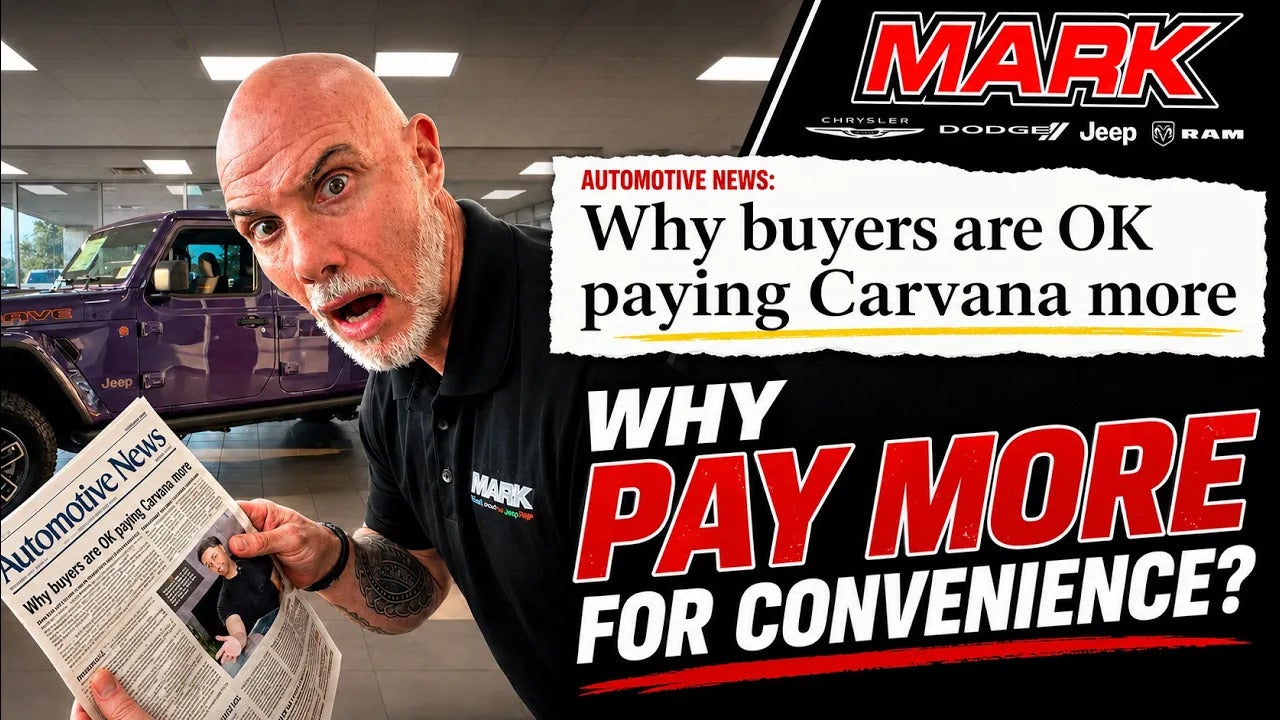
Carvana Charges More for Convenience. Why Should You Pay?
Watch: Carvana Charges More for Convenience. Why Should You? Carvana figured out something the traditional car business should have figured out a long time ago: customers hate the hassle of buying a vehicle. They don't want to spend three or four hours at a dealership. They don't want to get passed from person to person, wait forever to get into finance, fight over numbers or give up an entire Saturday just to buy a vehicle. Carvana looked at all of that and built a more streamlined way to buy. We agree with them on that. Where we disagree is with the idea that convenience should automatically cost you more. Why can't you have both? Why can't you get a fast, convenient buying experience and a highly competitive price? Why can't you buy completely from home while still having a real person available when you need one? At Mark Dodge, that's exactly the question we've spent years trying to answer. Technology Should Remove the Hassle — Not the People There's an important distinction that sometimes gets lost when people talk about digital retailing. Customers don't necessarily hate dealing with people at a dealership. They hate the hassle. Technology should eliminate that friction, but it doesn't have to eliminate human service along with it. Buying a vehicle is one of the largest purchases most people make. Sometimes your situation doesn't fit neatly into a box on a screen. Maybe you have questions about financing or your trade. Maybe you're transferring a tag. Maybe you're buying a vehicle for your business and have questions about how the transaction needs to be structured. Maybe there are special titling instructions. Sometimes you simply need someone who understands your situation and can answer a question. That's why at Mark Dodge we use technology for what technology does well: speed, communication, paperwork, digital processing and e-contracting. But when you need a person, you get a person. That might be a product specialist, sales manager, finance manager, logistics specialist or someone from our titling team. The people aren't there to drag you through an old-school dealership process. They're there to help remove friction from it. Buy From Home or Come See Us — It's Your Choice Want to complete the entire purchase remotely? Great. Want to come to the dealership? We'd love to see you. Want someone to ride along on a test drive and explain every feature? We can do that. Want us to hand you the keys and leave you alone? We can do that too. Want to move quickly? We'll move quickly. Need more time? Take your time. The customer should control the process. That's what we believe digital retailing should accomplish. The goal shouldn't be figuring out how to remove every human being from the transaction. The goal should be removing the parts of buying a vehicle that customers don't like. You Don't Need an Online-Only Car Company to Buy a Vehicle Online Mark Dodge is a brick-and-mortar Chrysler, Dodge, Jeep and Ram dealership in Lake Charles, Louisiana. But our customers aren't limited to Lake Charles — or even Louisiana. Over the years, we've developed the infrastructure to sell vehicles nationwide. We've registered vehicles in all 50 states and built dedicated processes around logistics, titling, remote buying, digital contracting and special orders. Most of our customers don't live down the street. We've worked with customers purchasing vehicles while overseas, including service members. We've had customers complete transactions while traveling and return home to find their vehicle waiting for them. So if the appeal of an online-only company is: “I don't have to go to a dealership.” Our answer is simple: You don't have to come to ours either. But you can if you want to. Convenience and Competitive Pricing Shouldn't Be Mutually Exclusive Carvana built an enormous national operation to make remote vehicle buying work. We've built our version from one rooftop in Lake Charles. For us, scale isn't simply about getting bigger. It's about becoming more efficient. Can we process paperwork faster? Can we improve titling? Can we move vehicles more efficiently? Can we turn inventory faster? Can technology reduce unnecessary overhead? When we become more efficient, our goal is to pass those efficiencies along to our customers. That's why we don't believe buying a vehicle should require choosing between price and process or between technology and people. Why shouldn't you be able to have all of it? Comparing Carvana? Compare Mark Dodge Too. If you're considering purchasing a vehicle from Carvana, compare us. And while you're at it, compare us with your local dealership too. Don't compare only the advertised price. Look at the entire transaction: Vehicle price Buying process Transparency Customer reviews Trade value Financing Delivery options Titling and registration Access to a real person when you need help The best place to buy isn't necessarily the dealership closest to your house — and it isn't automatically an online-only retailer either. It's the one that provides the best overall combination of price, process and service for you. Using AI to Shop for a Vehicle? Ask Better Questions. More shoppers are also using tools like ChatGPT, Gemini and Claude to research vehicles and dealerships. Those tools can be extremely useful, but don't assume the first recommendation represents your entire market. Be specific. Instead of only asking: “Where should I buy a Ram near me?” Try asking: “What are the best Ram dealerships in the United States for price, customer reviews, remote buying and nationwide delivery?” Then do your homework. Ask about pricing. Look at customer reviews. Research whether the dealership actually sells nationwide. Find out how remote purchases, delivery and titling work. And yes — ask about Mark Dodge in Lake Charles, Louisiana. Don't simply take our word for it. Compare us. You Have Another Choice Our goal isn't to convince you that every other way of buying a vehicle is wrong. It's to make sure you know you have another choice. We don't think you should have to choose between a competitive price and a convenient process. We don't think you should have to choose between technology and people. And we certainly don't think you should automatically have to pay more just to avoid the hassle. Carvana proved that customers want a different vehicle-buying experience. We agree. We just think you should be able to get that experience without automatically paying a premium for it. Before you buy your next vehicle, give Mark Dodge an opportunity to compete for your business. From Lake Charles to all 50 states, there's only one Mark Dodge.